
TECHNICAL INSIGHTS · October 29, 2026
How to Choose PCD Cutting Tools for High-Silicon Aluminum Cold Plates
A practical guide to PCD, MCD, CVD/MCD and carbide tooling for high-silicon aluminum cold plates, sealing lands and deep coolant channels.
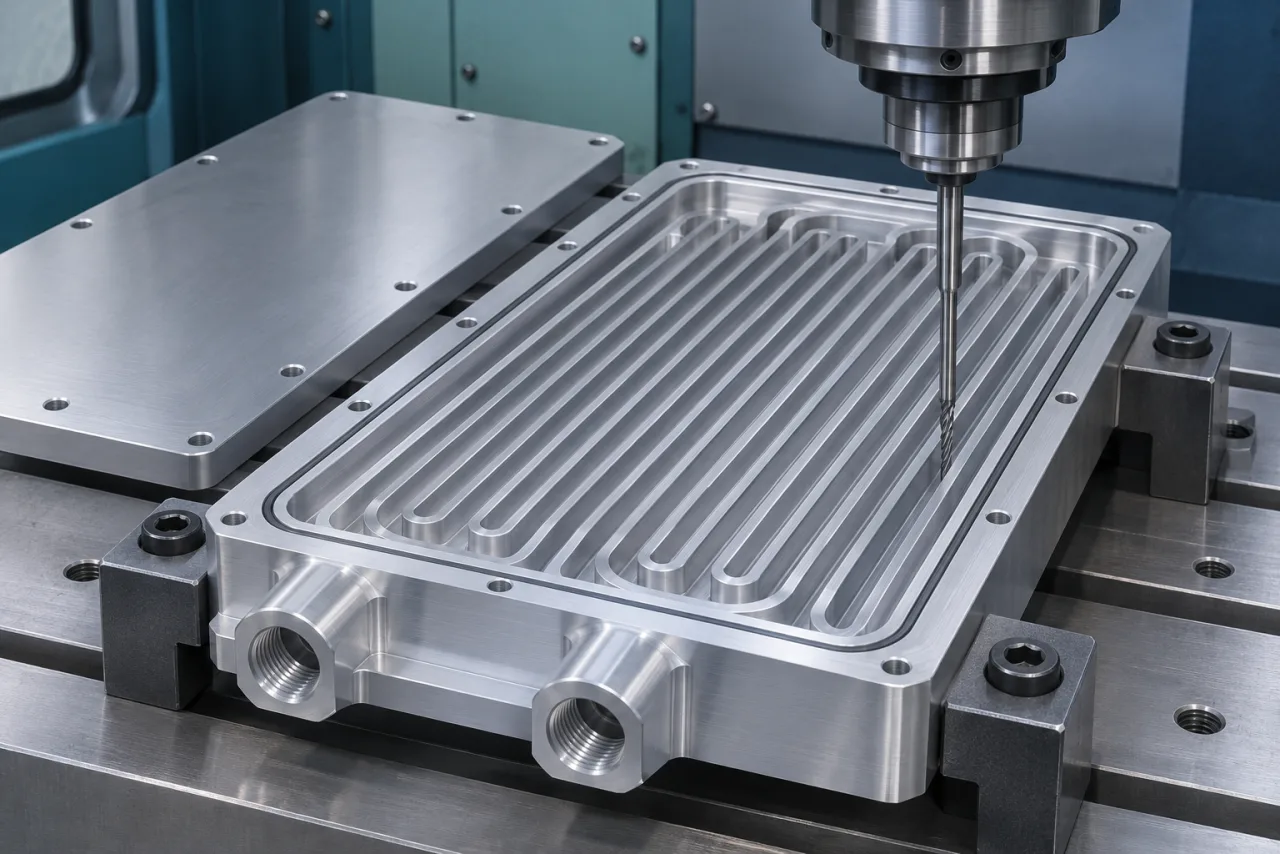
High-silicon aluminum is a preferred material for liquid-cooling cold plates, manifolds and compact heat exchangers because it combines low weight with useful thermal conductivity. It is also one of the more demanding non-ferrous alloys to machine. Silicon particles are abrasive, while the aluminum matrix is soft enough to smear across a cutting edge. In a cold plate, a small burr at a sealing land or a rough channel wall can create leakage risk, disturb coolant flow or add a costly manual finishing step.
For production teams, the tooling decision is therefore more than a choice between sharp and strong. The tool must hold geometry through long channel runs, evacuate chips from narrow passages and deliver a stable surface finish on both the pocket floor and the sealing face. A PCD diamond tool is often the starting point for this work, with solid carbide used where flexibility, very small diameters or interrupted cuts make it the better fit.
Where high-silicon aluminum creates a machining problem
High silicon content increases abrasive wear on conventional carbide edges. At the same time, the aluminum phase can form built-up edge when cutting speed, lubrication or edge preparation is not well matched to the alloy. The result may be a raised burr on the channel exit, a torn edge around threaded ports or a dull-looking sealing surface. These defects are especially visible after anodizing or leak testing.
Cold plates add another constraint: the geometry is usually deep and narrow. A tool with insufficient flute space may recut chips, and a tool with too much radial engagement can deflect in a thin wall. The best process window balances tool rigidity, chip evacuation and heat control rather than simply increasing spindle speed.
Choosing PCD for channel floors and sealing faces
PCD (polycrystalline diamond) provides a wear-resistant cutting edge and a low-friction surface against aluminum. It is well suited to finishing operations where dimensional stability and a clean edge are more important than maximum material removal. MicroDrill can supply PCD end mills, form tools and custom profiles for channel floors, O-ring grooves, port seats and other drawing-defined features. See the PCD tooling details page for the product range.
Use a positive, sharp geometry for aluminum, with enough flute space to move chips out of the channel. A small corner radius can protect the edge without leaving a large witness mark. For a sealing land, keep the final radial engagement consistent and avoid letting the tool dwell at the end of the pass. A separate light finishing pass is usually easier to control than asking one tool to rough, semi-finish and finish the same surface.
When solid carbide is the right choice
Carbide remains useful for pilot holes, deep narrow features, roughing and very small diameters. A solid carbide micro drill can reach a port or cross-hole that is impractical for a larger PCD body. For these operations, tool runout and workholding often matter as much as the grade. MicroDrill’s tungsten carbide micro drills and end mills can be specified by diameter, flute length, shank and coating requirements.
For roughing, choose a flute design that opens the chip pocket and leaves a predictable allowance for the PCD finishing tool. Avoid burying a small tool in a full-width slot when a trochoidal or adaptive path can maintain a more stable radial load. If coolant access is limited, air blast or minimum-quantity lubrication can help keep chips from welding back onto the edge; validate the method against your coolant and material specification.
Process practices that protect accuracy
- Verify runout before cutting. Measure at the tool tip, not only at the holder. A small error is amplified in a narrow sealing groove.
- Separate roughing and finishing. Leave a controlled allowance, then finish in one consistent direction where possible.
- Control chip evacuation. Use through-tool coolant, air or a programmed retract when chips can pack in a deep channel.
- Inspect the functional surfaces. Check burr height, channel width, sealing flatness and leak-test results instead of relying on appearance alone.
- Match the tool to the drawing. PCD form tools and custom carbide tools made to drawing can reduce secondary deburring and protect the delivery schedule.
PCD, MCD and CVD/MCD options
PCD is the practical choice for many production aluminum cuts because it combines diamond wear resistance with a robust brazed or engineered tool body. MCD and CVD/MCD diamond solutions can be considered when an extremely sharp edge, high gloss finish or a specialized profile is required. MicroDrill’s CVD/MCD high-gloss diamond tools are intended for precision non-ferrous finishing, while PCD is often preferred for general channel milling and longer rough-to-finish cycles. The correct option depends on alloy silicon content, surface requirement, tool diameter and batch size.
How MicroDrill supports cold-plate programs
Shenzhen MicroDrill Precision Tools Co., Ltd. supports prototype, small-batch and OEM/ODM production. Share the cold-plate drawing, alloy grade, machine platform and target surfaces through our inquiry page. Our team can recommend a tool family, confirm a manufacturable geometry and prepare samples before a larger release. This approach helps engineering and purchasing teams reduce trial-and-error while keeping quality and delivery requirements visible from the start.
FAQ
Is PCD suitable for high-silicon aluminum cold plates?
Yes. PCD is commonly selected for stable finishing of aluminum alloys containing abrasive silicon. The geometry and process still need to be matched to the channel depth, wall thickness and required surface finish.
Should I use PCD for every operation?
No. Solid carbide may be more practical for pilot holes, very small diameters, roughing or interrupted cuts. A mixed process often gives the best balance of flexibility and wear resistance.
How can I reduce burrs at channel exits?
Use a sharp edge, support the exit where possible, reduce the final radial load and finish with a controlled path. Inspect the actual burr and adjust tool geometry or allowance rather than relying on speed changes alone.
Can MicroDrill make a tool to our cold-plate drawing?
Yes. Custom PCD, MCD, CVD/MCD and carbide tools can be developed from drawings or samples, subject to a technical review.
Need a cleaner channel wall or a more reliable sealing surface? Send your cold-plate drawing and machining details to MicroDrill for a practical tooling recommendation.