
TECHNICAL INSIGHTS · October 27, 2026
PCD, MCD and Carbide Tools for AI Liquid-Cooling Components: A Selection Guide
A practical guide to selecting PCD, MCD, CVD/MCD and solid-carbide tools for aluminum cold plates, copper components, manifolds and precision cooling hardware.
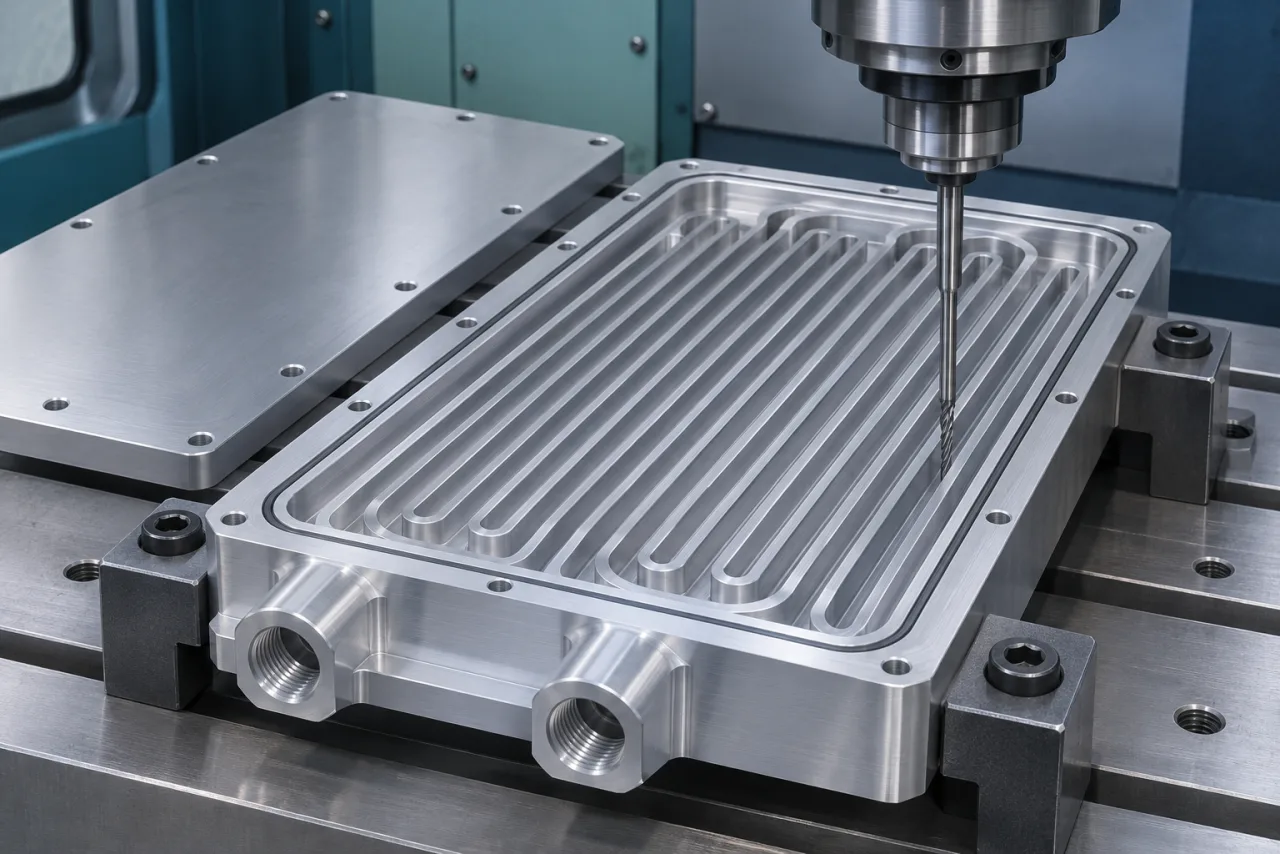
AI infrastructure is creating a new wave of demand for cold plates, liquid manifolds, heat spreaders and compact thermal modules. These parts are often machined from aluminum or copper and may include deep pockets, micro-channels, cross-drilled ports and high-quality sealing faces. Tool selection has a direct effect on cycle time, burr control, surface finish and repeatability.
This practical guide compares PCD, MCD, CVD/MCD and solid-carbide tools for liquid-cooling components. The goal is not to choose the most expensive tool, but to match the cutting edge to the material, feature and quality requirement.
1. PCD tools for abrasive aluminum and composite components
Polycrystalline diamond (PCD) is a productive choice for high-silicon aluminum, abrasive aluminum castings, graphite and selected composite materials. PCD end mills can support stable channel and pocket dimensions over longer runs, while PCD form cutters can combine radii, steps or contour features in one pass.
Choose PCD when tool wear is driving dimensional drift, when burrs are increasing inspection time, or when a standard carbide cutter cannot maintain the required output. The correct edge preparation and chip space still depend on alloy, spindle speed, feed and coolant delivery.
2. MCD and CVD-MCD for high-gloss finishing
Monocrystalline diamond (MCD) and CVD/MCD high-gloss tools are designed for extremely sharp edges and very low cutting forces in compatible non-ferrous materials. They are useful for visible aluminum covers, thermal contact lands, sealing faces and other surfaces where reflection and roughness matter.
These tools are a finishing solution, not a universal replacement for carbide or PCD. Confirm material compatibility, interrupted-cut conditions and machine rigidity before selecting a diamond edge. For ferrous steel, use a tooling solution intended for steel rather than assuming a diamond tool will perform well.
3. Solid-carbide micro drills for precision ports
Small coolant ports, sensor holes, vent holes and cross passages require a rigid tool with predictable runout. Solid-carbide micro drills are well suited to these features because they maintain stiffness at small diameters and can be specified with custom point, flute and margin geometry.
Pay attention to peck strategy, coolant pressure, chip evacuation and hole intersection. A clean entrance and exit, controlled burr height and verified position are often more valuable than simply increasing drilling speed.
4. Custom tools for manifolds and complex channels
Manifolds may combine several channel widths, stepped bores, angled ports and sealing shoulders. A custom PCD or carbide tool made to drawing can reduce tool changes and improve feature-to-feature consistency. For high-volume programs, the initial engineering cost can be recovered through shorter cycle time and fewer corrective operations.
Quick selection matrix
| Component or feature | Recommended starting point | Primary objective |
|---|---|---|
| High-silicon aluminum cold-plate channels | PCD end mill or form cutter | Wear resistance and stable dimensions |
| Visible aluminum thermal-contact face | MCD or CVD/MCD high-gloss tool | Low roughness and bright finish |
| Small ports and cross holes | Solid-carbide micro drill | Stiffness, position and burr control |
| Multi-step manifold geometry | Drawing-specific custom tool | Fewer operations and repeatability |
RFQ information that improves the recommendation
Share the material grade and hardness, the cooling-component drawing, channel and port dimensions, tolerances, target roughness, machine and spindle details, coolant method, batch size and current failure mode. If you have photos of burrs, chatter or tool wear, include them. This lets the tooling engineer compare PCD, MCD, CVD-MCD and carbide options against the actual process window.
Explore our PCD tools, CVD/MCD high-gloss tools and tungsten-carbide tools, or send a drawing for a custom quotation. MicroDrillTools supports precision tooling for aluminum, copper, graphite, composites and 3C components.
For broader AI data-center context, review Dell’Oro Group’s liquid-cooling market outlook and Microsoft’s technical infographic.