
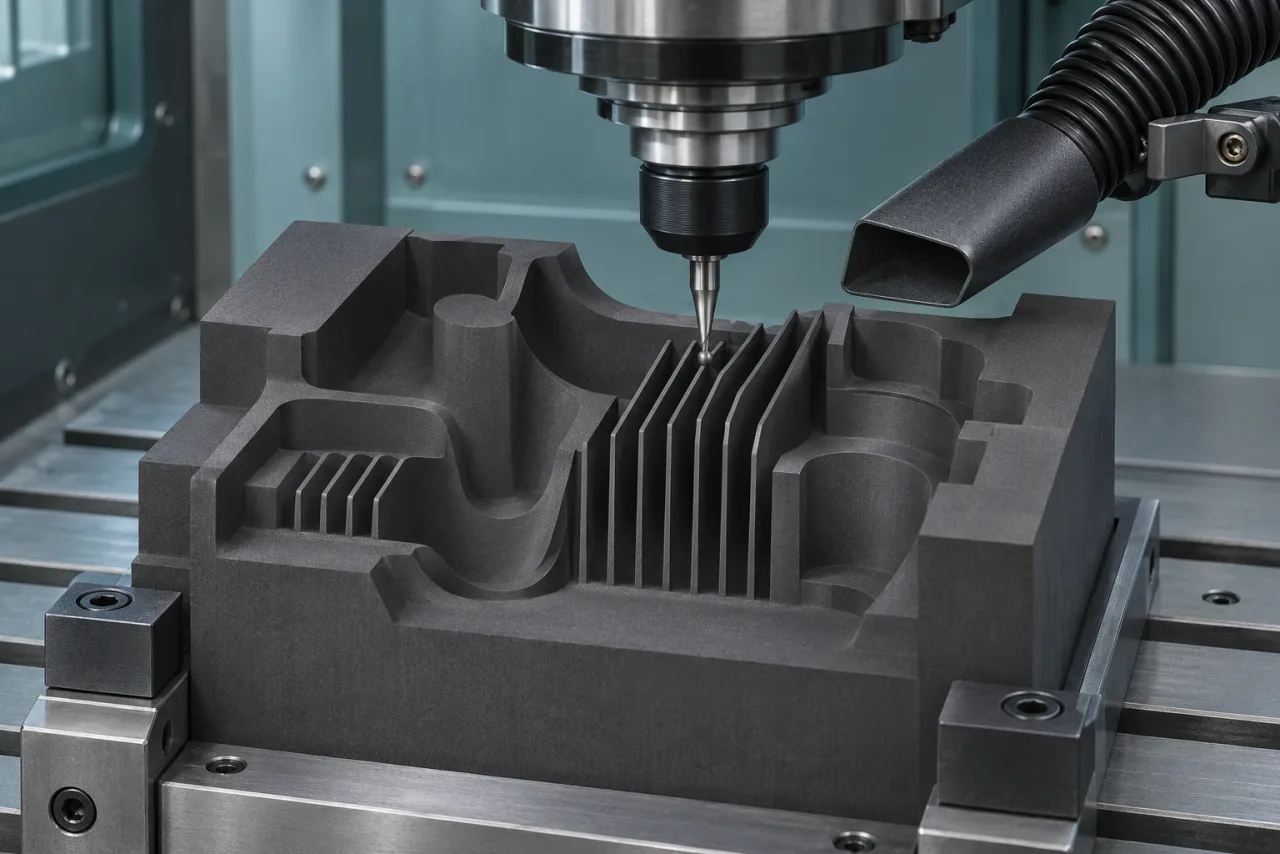
Graphite machining

Graphite & Graphite Electrodes

Diamond and carbide tooling options for graphite electrodes and mold components.

Discuss your application

Graphite machining

Graphite & Graphite Electrodes

Diamond and carbide tooling options for graphite electrodes, mold components and abrasive carbon materials.

Discuss this application
AI-generated application illustration

Start with the electrode feature

Share the graphite grade, roughing or finishing operation, feature dimensions, tool reach and quantity. A drawing can follow.

Tool selection and machine fit are confirmed after review.

01 · Customer pain points

Where production loses time

  • Graphite dust is abrasive and can accelerate flank wear, spindle contamination and edge rounding.
  • Weak or chipped edges affect electrode dimensions and mold surface quality.
  • Deep pockets and narrow slots make chip evacuation and tool rigidity critical.

02 · Tooling solution

How we configure the tool

  • Review PCD, CVD/MCD or carbide options according to graphite grade, electrode geometry and required finish.
  • Use the shortest practical tool setup, stable workholding and dust extraction to protect the process.
  • Separate roughing, semi-finishing and finishing requirements so one geometry is not asked to do every job.

03 · Application fit

Products to review

Use the pcd-tools family as a starting point. Final grade, geometry, dimensions and delivery are confirmed against the drawing and machining conditions.

View related tools

Graphite electrode cutter dimensions

For finishing, compare the PJM cutter envelope. For a formed radius, compare the PRX profile and reach against the electrode drawing. These catalog dimensions are a starting point for review against the graphite grade, pocket depth and required corner radius.

Order codeCutting diameter (mm)Shank diameter (mm)Overall length (mm)
PJM-PCD-16161670
PJM-PCD-20202075
PRX-R52016130
PRX-R62520130

MicroDrillTools approach

A clear path from pain point to production trial.

We combine drawing review, tool configuration, sample validation and inspection planning so the recommended geometry is tied to the actual workpiece.

  • Review PCD, CVD/MCD or carbide options according to graphite grade, electrode geometry and required finish.
  • Use the shortest practical tool setup, stable workholding and dust extraction to protect the process.
  • Separate roughing, semi-finishing and finishing requirements so one geometry is not asked to do every job.
01

Confirm graphite grade

Share density, grain size, electrode dimensions and feature geometry.

02

Choose the edge

Match diamond or carbide grade and flute form to roughing or finishing.

03

Measure the electrode

Inspect dimensions, corners, surface finish and dust-related process drift.

Implementation result: The desired outcome is a cleaner, more stable graphite process with better dimensional control and less unplanned tool replacement.

Purchasing specifications and application example

Specifications to check
The PCD catalog lists PJM-PCD-20 at 20 mm cutting diameter, 5 mm flute length, 20 mm shank and 75 mm overall. PRX-R6 has R6 mm, 25 mm cutting diameter, 20 mm shank and 130 mm overall. Confirm both reach and suitability for the graphite grade.
Application example
For a graphite EDM electrode with a fine corner, check the required corner radius, cavity depth and holder clearance. For a broad finishing surface, check cutter diameter and fixture clearance. Record corner chipping and dust extraction during the trial.

Read the application reference

Tool selection and quoting FAQ

What tool material is best for graphite?

PCD, CVD/MCD and carbide may each be considered depending on graphite grade, feature and finish target.

How do I reduce graphite dust problems?

Use suitable extraction, keep the spindle and holder clean, and choose a geometry that evacuates dust without rubbing.

Can you support electrode-specific profiles?

Yes. Drawing-led custom tooling is available for special profiles, reaches and small features.

How should I choose between a PCD cutter and a diamond-coated end mill for an EDM electrode?

State the graphite grade, operation, smallest corner, reach and edge-quality target. Check the PCD form-tool envelope against the drawing and evaluate a coated end mill if a small feature or different reach calls for another tool design.

Technical insight

Related machining guide

Compare cutter reach, corner radius and holder clearance with the electrode drawing before buying a replacement.

Graphite Electrode End Mills: Reach, Corner Radius and Holder Clearance

Request a custom graphite cutter

Send the electrode drawing, graphite grade, tool reach and edge-quality target.

Upload a drawing for a quote

Sourcing tools for resale or batch purchasing?

Discuss the product range, your market and purchasing requirements. A specific model can follow.

Start a cooperation enquiry Wholesale & distributor enquiries