
TECHNICAL INSIGHTS · October 29, 2026
PCD vs Solid Carbide Tools for CFRP and UAV Aluminum Parts
Compare PCD and solid carbide tools for CFRP, GFRP and 6061/7075 UAV components, with practical advice for burr control, delamination and custom tooling.
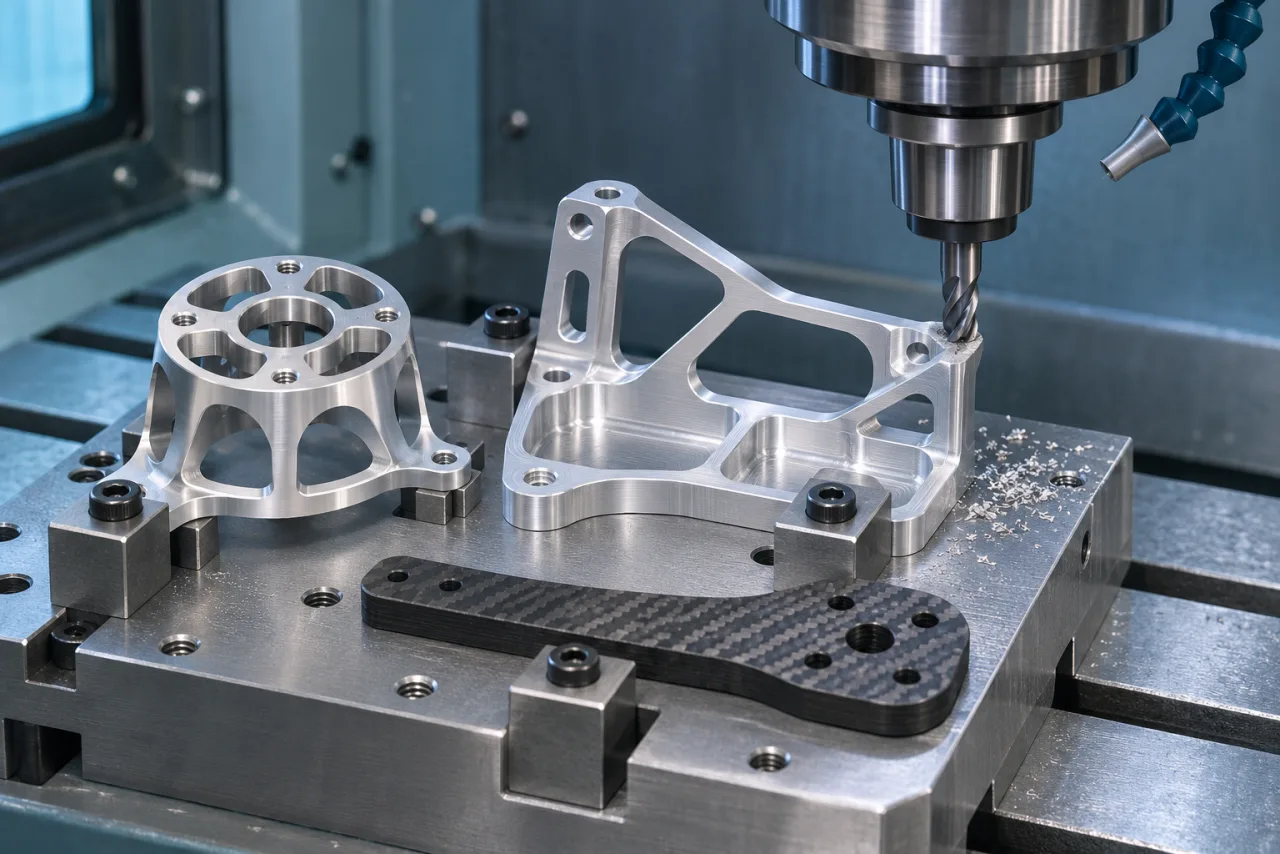
CFRP and GFRP help UAV designers achieve a high strength-to-weight ratio, while 6061 and 7075 aluminum provide threads, mounts and heat-spreading interfaces. The combination is excellent for airframes, brackets and payload structures, but it is unforgiving to machine. Composite plies can delaminate or fray, aluminum can raise a burr or weld to the edge, and the same assembly may require both a diamond cutting edge and a flexible carbide micro tool.
For CNC engineers and buyers, the most reliable strategy is to select tooling around the material interface and the finished function. A PCD tool can provide a clean, wear-resistant edge on abrasive composite and aluminum surfaces. A solid carbide drill or end mill remains valuable for small holes, pilot features and operations where tool diameter or interruption makes PCD impractical.
The real pain points in UAV composite machining
In CFRP, the cutting edge must separate fibers without pulling the laminate apart. Dull or poorly supported edges can create delamination at the entry and exit, exposed fibers around fastener holes and a rough edge that requires hand finishing. GFRP is less abrasive than carbon fiber in some applications, but glass fibers still accelerate wear and can produce a fuzzy edge.
When a composite part is bonded or assembled to aluminum, a mismatch in hole quality can slow the entire line. A clean composite hole may still fail if the aluminum side has a burr that prevents a flush fastener. The process must therefore control both materials, chip evacuation and heat in the same setup.
Why PCD is often chosen for CFRP and aluminum
PCD combines diamond wear resistance with a geometry that can be optimized for non-ferrous cutting. In CFRP, it can maintain edge sharpness through abrasive plies; in aluminum, it can reduce the tendency for material to adhere when the edge and surface speed are matched correctly. MicroDrill’s PCD diamond cutting tools can be supplied as end mills, drills, form tools or custom profiles for UAV components.
For trimming a composite skin, use a tool geometry that supports clean fiber separation and provides sufficient chip space. For an aluminum pocket or mounting face, a positive cutting action and polished flute can help manage built-up edge. The exact edge preparation, helix and point style should follow the laminate stack, aluminum grade and machine capability rather than a generic catalog setting.
When carbide micro tools make more sense
Solid carbide is often the practical choice for small-diameter holes, spot drilling, shallow pilots and features that are interrupted by fastener interfaces. MicroDrill’s tungsten carbide micro drills and end mills can be configured for the required diameter, flute length, shank and coating. A carbide pilot tool can also help establish a stable entry before a larger PCD tool opens the feature.
For aluminum-only details, carbide can be economical for prototypes or low-volume work. If the same tool must cut a large volume of abrasive composite, however, tool life and consistency should be reviewed together with piece price. A short trial that records hole size, burr or fiber pull-out and edge condition is more useful than comparing purchase prices alone.
Practical process guidance for hybrid parts
- Back up the laminate. A sacrificial support or fixture close to the exit reduces delamination risk, especially on thin skins.
- Keep the tool path predictable. Avoid rubbing, dwell and unnecessary full-width engagement; stable chip load is more important than a dramatic speed increase.
- Control dust and chips. Use extraction suitable for carbon or glass fiber and keep abrasive dust away from guides and spindles.
- Sequence the operations. Spot, drill and finish in a sequence that leaves a supported edge for the final pass. Use a separate tool for aluminum countersinks when needed.
- Inspect the interface. Measure hole diameter, roundness, delamination, fiber breakout and aluminum burr height at the same sampling points.
Choosing between PCD, MCD and CVD/MCD
PCD is commonly selected for general trimming, drilling and milling of CFRP, GFRP and aluminum. MCD and CVD/MCD diamond tools are options for applications where an exceptionally sharp edge, high gloss or a specialized micro profile is the priority. Review MicroDrill’s CVD/MCD high-gloss diamond tools when the component includes a cosmetic aluminum surface or a precision finishing feature. The right selection depends on fiber type, resin, aluminum alloy, cut interruption and expected batch size.
Custom tooling for UAV production
UAV components often change during qualification. A mounting hole may move, a composite stack may gain a protective layer, or a new bracket may combine CFRP with 7075 aluminum. MicroDrill can develop custom carbide tools made to drawing as well as custom PCD and diamond tools. Provide the drawing, laminate details, aluminum grade, machine and quality limits through the inquiry page. Sampling and small-batch support can help the engineering team validate the process before committing to production quantities.
FAQ
Are PCD tools suitable for both CFRP and UAV aluminum?
They can be, provided the geometry is designed for the actual materials and operation. A dedicated tool or separate edge design may still be preferable when the composite and aluminum cuts have different requirements.
How do I prevent delamination in CFRP holes?
Support the exit, keep the tool sharp, control axial load and use a stable entry and exit path. Validate the result on the actual laminate stack rather than on a coupon with different backing.
When should I choose carbide instead of PCD?
Carbide is often practical for very small diameters, pilot holes, interrupted cuts and prototypes. PCD is attractive when abrasive composite volume and dimensional consistency make wear resistance a priority.
Can MicroDrill supply OEM or ODM UAV tooling?
Yes. MicroDrill supports drawing-based custom tools, prototypes, small batches and OEM/ODM programs for composite and non-ferrous components.
Need a cleaner composite hole or a burr-free aluminum interface? Send MicroDrill your UAV part drawing and material stack for a tailored PCD, MCD, CVD/MCD or carbide solution.