
TECHNICAL INSIGHTS · October 31, 2026
Liquid-Cooling Tooling Solutions for Aluminum Cold Plates and Manifolds
AI servers and high-density electronics are increasing […]
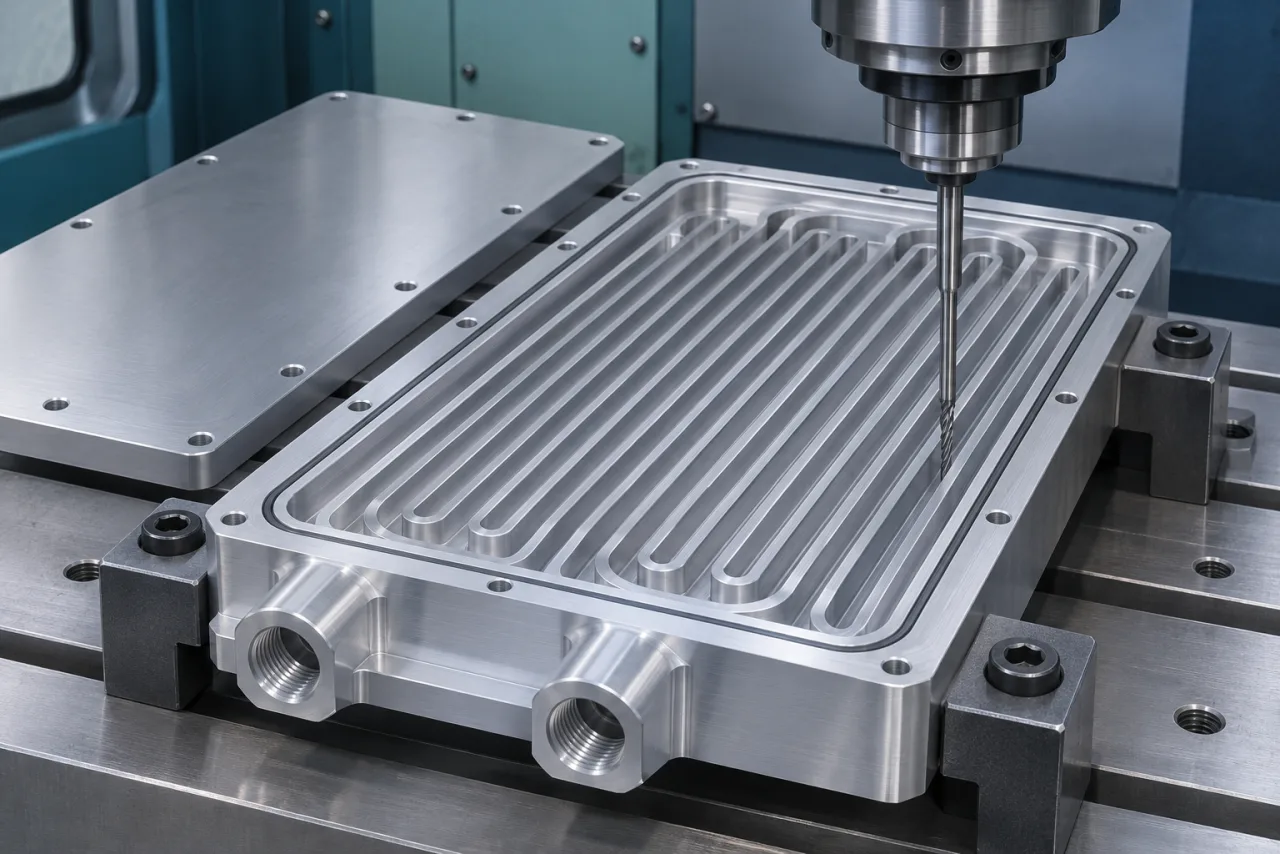
AI servers and high-density electronics are increasing demand for aluminum cold plates, manifolds and precision liquid-cooling parts. These components often combine deep channels, thin walls, sealing surfaces and a strong visual or dimensional requirement. The cutting tool must remove material efficiently without damaging the channel geometry or the finish that supports sealing and assembly.
Three liquid-cooling machining pain points
1. Channel accuracy and burrs
Small burrs left in a channel can affect cleaning, flow paths or assembly. A geometry selected only for material removal may not provide the edge control needed around ports and sealing faces.
2. Heat, built-up edge and surface marks
Aluminum alloys, especially high-silicon grades, can create built-up edge or surface smearing when the edge, speed and chip evacuation are not balanced.
3. Tight schedules with changing part revisions
Cold-plate designs can change quickly. A standard tool may not fit a new channel width, reach or corner radius, and late tool changes can delay validation.
Customized solution
Material and geometry review: We review the aluminum grade, channel width and depth, wall thickness, sealing surfaces, corner radii and machine access. PCD or MCD/CVD diamond tooling can be considered for suitable non-ferrous finishing and wear conditions; solid carbide remains useful for many drilling and roughing tasks.
Tool specification: The drawing defines diameter, reach, flute or edge geometry, corner treatment, shank and inspection points. Where a cold plate has several channel sizes, the tool family can be organized to reduce setup confusion.
Validation: Sample machining should check channel dimensions, burrs, surface appearance, chip evacuation, cleaning requirements and repeatability across the batch.
Expected implementation result
The result is a documented tooling route that helps the customer control channel quality and revision changes. Performance should be measured against the customer’s baseline—dimensional capability, burr removal, surface finish, cycle time and tool changes—rather than an unverified universal life claim.
Start with your cold-plate drawing
Send the part drawing, aluminum grade, channel details, machine information and current machining problem. We can help define a standard, custom or small-batch tooling plan for cold plates and manifolds.
Discuss a liquid-cooling tooling project or contact sales@microdrilltools.com.