
KHOAN VÀ PHAY PCB · November 20, 2026
PCB Routing Cutter RFQ: Slot Width, Stack Height and Edge Quality
Prepare a PCB router RFQ with finished slot size, board stack, edge acceptance and tool geometry. Includes a purchasing checklist and drawing review entry.
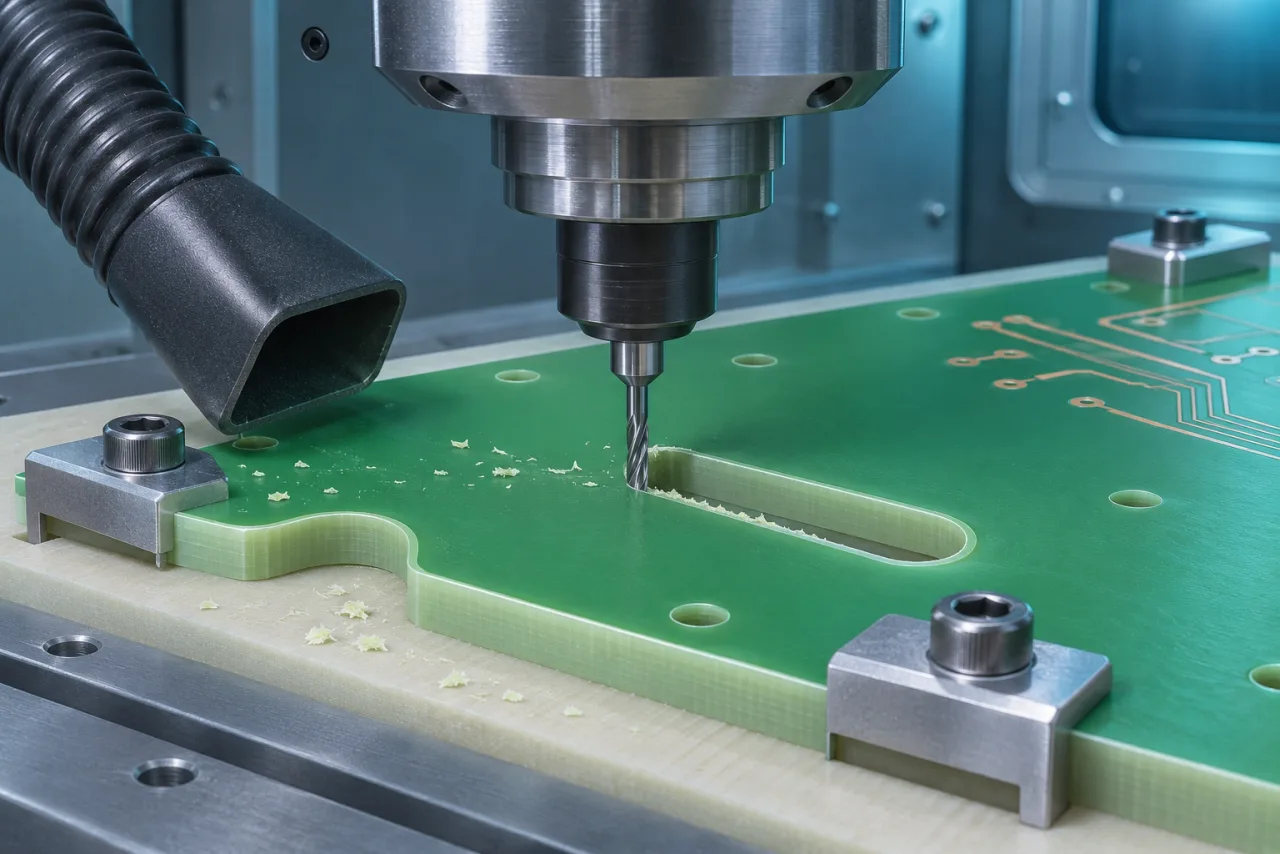
A request for a “PCB milling cutter” can describe an outside profile, a narrow through-slot or a shallow recess. Sending the same diameter to three suppliers does not ensure that they are quoting the same job. The finished feature, board stack and edge acceptance need to travel with the tool specification.
This checklist helps purchasing and process teams prepare a drawing-led RFQ. It covers the information needed to compare proposals; it does not prescribe a universal speed, feed, coating or tool life.
Start with the finished feature, then describe the cutter
Mark the routed contour or slot on the board drawing and identify its revision. State whether the feature passes through the board or stops at a controlled depth. Include the finished width, tolerance, internal corner requirements and the surface used as the inspection reference.
Keep the finished slot width separate from the nominal cutter diameter. Ask the supplier to identify the proposed tool and the assumptions behind the machining approach. A drawing requirement describes the accepted part; a tool diameter describes one element of the process. Record both rather than replacing the part requirement with a catalogue number.
Separate single-board thickness from routing stack height
State the laminate or substrate designation, the thickness of one board and the number of boards cut together. Add any entry or backing material and explain how the stack is supported. If a recess only cuts part of the thickness, give its actual depth separately.
List the required cutting length, usable reach and holder clearance as different checks. A longer overall tool is not automatically a suitable replacement for a longer cutting section. Include the machine and holder interface, shank requirement and intended protrusion so that the proposal can be reviewed against the setup.
Specify the edge that matters
Label the top face, underside and any edge that mates with another part. Attach a marked photograph or drawing detail showing the defect to be controlled: for example, top-edge burr, underside fiber breakout, an uneven wall or a dimension outside tolerance. Explain the inspection method and the agreed acceptance limit where these have already been defined.
For a replacement order, record the current cutter identification and the condition at which it is removed. “Better edge quality” is difficult to compare without a defined location and inspection method. A photograph is useful context, but should accompany the written requirement rather than act as its only definition.
Do not confuse diamond-cut geometry with diamond coating
A diamond-cut router description can refer to its cutting-edge pattern. It does not, by itself, establish that a diamond coating is present. In an RFQ, give substrate, edge geometry and coating separate fields. Ask for confirmation when a supplier’s description leaves one of these unclear.
Manufacturer literature illustrates why the distinction matters. UNION TOOL’s PCB router range lists diamond-cut geometry and diamond-coated routers in separate groups. It also distinguishes chip evacuation arrangements. These are examples of that manufacturer’s products, not specifications or performance claims for MicroDrill.
KYOCERA’s printed-wiring-board tool catalogue separately identifies contour-routing tools and tools for slitting or spot facing. Use this distinction to state the operation clearly; do not infer that a similarly sized cutter is an interchangeable substitute.
A purchase enquiry checklist
Use the following fields to make quotations comparable. Leave an unknown item open for engineering review rather than inventing a value.
- Part: drawing revision, routed feature, finished size and tolerance.
- Board: substrate designation, single-board thickness, stack count and support material.
- Operation: contour, through-slot or recess; cut depth; entry arrangement; extraction available.
- Tool: current reference if available; proposed diameter, cutting length, shank and reach to be confirmed.
- Setup: machine, holder, protrusion, workholding and the cutting conditions currently used.
- Acceptance: critical face, edge defect, dimensional inspection method and agreed rejection limit.
- Order: trial quantity, expected repeat quantity and requested delivery date for supplier confirmation.
Agree the first-article review before comparing cost
Ask each supplier to state what is included in its quotation and which engineering questions remain open. Record any proposed tool revision and the intended trial setup. Inspect the first article against the same drawing and edge requirements used in the enquiry.
Compare tool price separately from measured production results. If a trial is intended to compare cost per accepted board, record the accepted quantity, rejection criteria and tool-change point under the agreed conditions. Do not treat a supplier’s general life claim as a result from your own board and setup.
Request a PCB routing-tool review
MicroDrill reviews PCB tooling applications and made-to-drawing cutting-tool enquiries. Send the marked drawing, board and stack details, current tool reference if known, and trial quantity. Tool geometry, coating, feasibility and commercial terms require confirmation for the actual job.
Request a PCB routing cutter quote
Questions buyers ask
Is a diamond-cut router necessarily diamond coated?
No. Ask the supplier to confirm the edge geometry, substrate and coating separately.
Can I order using only the slot width?
Include the slot width, but also give its tolerance, depth, board stack and edge acceptance. The supplier needs the complete feature and setup to propose a tool.
What if the existing cutter code is unknown?
Provide the part drawing and measurable tool dimensions, identify any unknowns, and request an engineering review. A photograph alone may leave important geometry and interface details unresolved.