
DENTAL CAD/CAM TOOLING · November 6, 2026
Dental Zirconia Machining: Tool Selection by Sintering State
Dental zirconia machining is not one uniform cutting op […]
Dental zirconia machining is not one uniform cutting operation. A laboratory may mill a pre-sintered blank that is relatively easy to cut, or finish a fully sintered component whose hardness calls for a different tooling process. Confusing these states can lead to chipped margins, poor surface finish, accelerated tool wear, excess dust, or avoidable rework. The first useful question for a tooling review is therefore not simply “which cutter diameter?” but “what zirconia state, machine platform and operation are involved?”
Start by separating pre-sintered and fully sintered zirconia
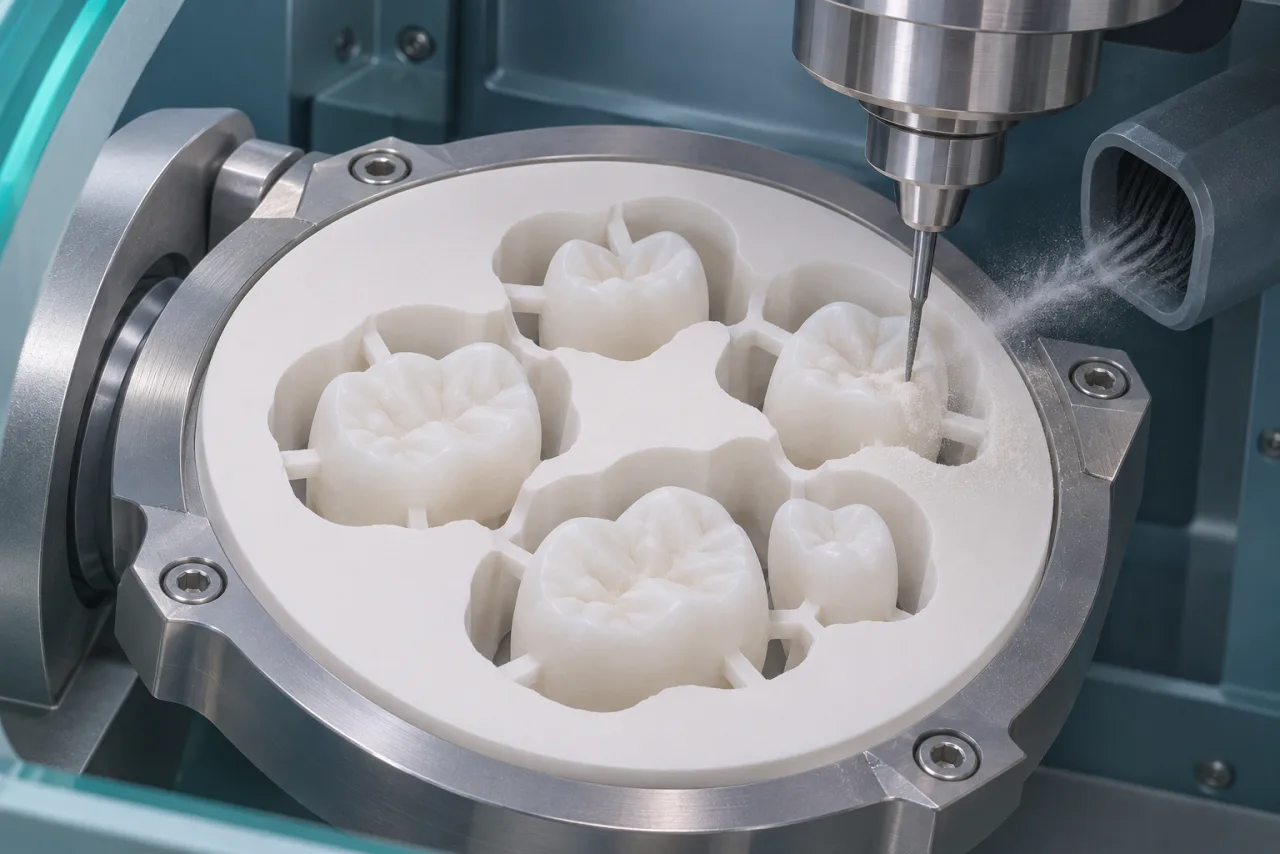
Many dental CAD/CAM workflows mill zirconia before final sintering. In this pre-sintered or “green” state, the blank is more machinable than the densified part, and the CAM workflow accounts for the material system and subsequent shrinkage. Tooling for this stage is commonly a material-specific carbide cutter designed for the machine and blank system. A finishing tool that works on one platform is not automatically compatible with another: shank interface, tool-length measurement, runout, tool library data and CAM compensation all matter.
Fully sintered zirconia presents a different problem. The hardened material is not interchangeable with a pre-sintered blank, and hard finishing is generally a grinding operation using an appropriate diamond abrasive tool system. Do not transfer cutting data, tool life expectations or geometry assumptions from a green-milling process to hard finishing. Follow the blank, machine, tool and CAM suppliers’ validated instructions for the exact material and equipment combination. The manufacturer references at the end of this guide describe these distinctions and the need for material-specific tools and workflows.
Control the common causes of chipped margins and inconsistent fit
When a margin chips, inspect the whole process before changing only the cutter. Check whether the blank state and material program match, whether the tool has reached its replacement threshold, and whether the spindle and holder are clean and correctly seated. Small tools are sensitive to runout and tool-length errors. Verify the machine’s tool measurement procedure, inspect the collet and taper, and compare the result with the platform’s maintenance guidance.
Next review the CAM sequence. Roughing, rest machining and fine margin passes place different demands on tool diameter and edge condition. A tool that is too large for a narrow fissure or deep feature may rub or leave stock that the finishing pass cannot remove cleanly. Conversely, a very small finishing cutter used to remove too much stock can be overloaded. Keep the finishing allowance and toolpath strategy tied to the blank manufacturer’s and CAM system’s instructions; there is no universal feed, speed or step-over that applies across machines and zirconia formulations.
Dust management is part of process control. Dry milling pre-sintered zirconia produces fine particulate. Use the machine’s intended extraction and cleaning procedures, keep the work chamber and tool interface clean, and follow the equipment maker’s instructions for filters and maintenance. Poor extraction can contaminate machine components and make tool inspection less reliable. Where a workflow is specified as dry, do not introduce coolant without checking system compatibility.
Specify the tool around the feature and machine
For a quote or engineering review, identify the material brand and state, machine model, holder or shank interface, operation, smallest feature, maximum reach and desired finish. Include whether the job is roughing, margin finishing, fissure detail or another operation. For custom geometry, a drawing or the machine’s approved tool specification is more useful than a general description such as “small zirconia cutter.”
Solid-carbide tooling is a reasonable category to review for pre-sintered milling when its geometry and interface match the equipment and process. Diamond abrasive tools are the category to review for suitable hard-finishing work on fully sintered zirconia. PCD or MCD cutters should not be selected simply because they contain diamond: their cutting geometry and intended work materials differ from a diamond grinding tool. MicroDrillTools publishes dental zirconia application guidance and solid-carbide tool families; application-specific suitability and platform compatibility require engineering review. The public catalog should not be read as a claim that every dental machine or restoration workflow is supported.
Build a repeatable purchasing and validation checklist
Before approving a replacement or custom tool, record the exact blank type and sintering state, approved machine platform, tool identifier, usable cutting length, tool-length offset procedure and CAM tool record. During a controlled trial, inspect margins and small details under the lab’s normal quality method, review tool condition at a consistent interval, and note any changes to fit or surface appearance. Keep the same blank, machine, holder and CAM strategy while comparing tool options; changing several factors at once makes the outcome difficult to interpret.
For repeat orders, retain the drawing or reference tool, revision, machine interface and approved operating context. Ask the tool supplier to confirm any proposed geometry change against that reference. If the blank supplier revises its material or the lab changes machine or CAM software, recheck the process rather than assuming the previous tool data remains valid.
Frequently asked questions
Can the same cutter be used for pre-sintered and fully sintered zirconia?
Do not assume so. Pre-sintered milling and fully sintered hard finishing are different processes and typically use different tool systems. Follow the specific blank and machine documentation.
Should zirconia be machined dry?
Many pre-sintered dental zirconia workflows use dry milling with suitable extraction. The correct method depends on the machine, blank and validated CAM process.
Can PCD or MCD replace a dental diamond grinding tool?
Not by material name alone. PCD/MCD cutting tools and diamond abrasive grinding tools have different constructions and applications. Confirm the operation and platform before specifying a tool.
What information should I send for a custom tool inquiry?
Share the machine model, blank brand and state, operation, tool interface, geometry or drawing, and the issue you need to address. Final recommendations are subject to engineering review and confirmation.
Request an application review
Need help documenting a zirconia tooling requirement? Use the product catalog to identify the relevant tool category, or send the machine, blank and feature details through MicroDrillTools’ dental zirconia application inquiry. Custom dimensions and tool concepts are subject to engineering review and confirmation.
Technical references: imes-icore, Zirconia in Dental Technology; vhf, Dental Milling and Grinding Tools.
Before selecting an alternative cutter, compare the installed collet, tool envelope and CAM definition with our dental milling bur compatibility checklist.